The 2026 Super El Niño: Navigating the Most Powerful Climate Event in a Generation
The 2026 Super El Niño is shaping up to be the most powerful climate event in a generation. Learn how it works, what makes this one different, and what scientists are doing to predict and mitigate its effects.
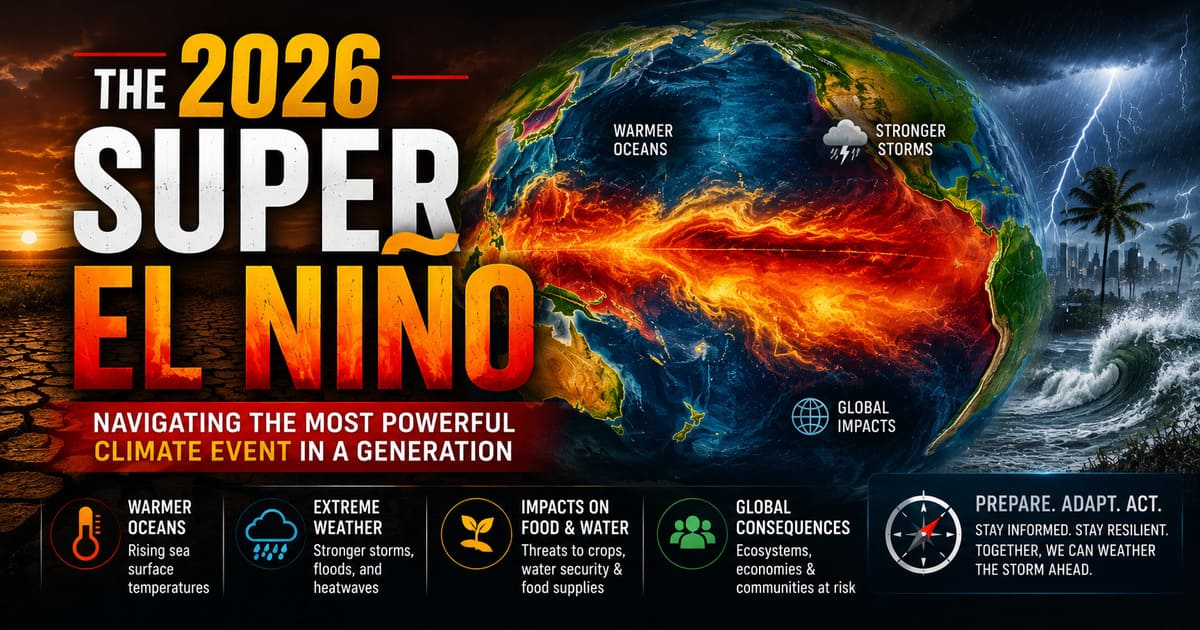
For the past three months, NASA satellites have been tracking a massive, continent-sized body of water sitting 7.5°C hotter than the surrounding ocean. This thermal anomaly is currently making its way across the Pacific on a 9,000-mile pilgrimage from the Philippines to Peru.
Oceanographers call this a Kelvin wave, and it serves as the opening act for El Niño—a recurring climate event that has disrupted weather systems across every continent on Earth long before humanity began keeping records. But this time, the context is entirely different. This El Niño is arriving on a planet that is already hotter than it has ever been in recorded history, and scientists are warning that what is coming could be the most powerful and destructive El Niño in modern history.
The Mechanics of the Pacific Pendulum
To understand the gravity of the current situation, we have to look at how the Pacific Ocean normally operates. Covering a third of the planet’s surface, the equatorial Pacific is driven by trade winds—permanent east-to-west prevailing winds. These winds exist because the equator receives the most direct sunlight, intensely heating the surface and causing warm, moist air to rise. This creates a low-pressure zone that pulls in cooler air from the subtropics, which is then deflected westward by the Earth’s rotation.
These trade winds push the sun-heated surface water westward, creating a massive warm pool near Indonesia and the Philippines. As this water moves, it exposes the thermocline—a sharp thermal boundary just below the surface where temperatures drop drastically. In the eastern Pacific, off the coast of South America, this allows cold, nutrient-rich water to punch through to the surface in a process called upwelling. This upwelling forms the foundation of some of the most productive fishing waters on Earth and helps stabilize global wind patterns.
However, this delicate balance is a pendulum. Every two to seven years, the trade winds slacken or collapse. The “water mountain” held up off the coast of Asia collapses back downhill, sloshing eastward and releasing a deep pulse of heat known as a downwelling Kelvin wave.
The Perfect Storm of 2026
While predicting the exact trigger of an El Niño remains a complex science, the buildup to the current event has been unprecedented. From 2024 through late 2025, stronger-than-normal trade winds drove an unusually deep and hot warm water pool toward the western Pacific.
The tipping point occurred in early April 2026. Between April 4th and 8th, three tropical cyclones—Malak in the Solomon Sea, Vianu in the South Pacific, and the Category 5 super typhoon Sinlaku near Micronesia—spun up almost simultaneously along the equator. Because of the Earth’s rotation, storms in the Northern Hemisphere spin counterclockwise, while those in the Southern Hemisphere spin clockwise. As these three massive storms aligned, their combined wind forces briefly fused into a sustained countercurrent, effectively reversing the trade winds for nearly a week.
This reversal was the catalyst. It released an avalanche of warm water that had been dammed in the western Pacific. Throughout April and May, a slab of water up to 8°C warmer than its surroundings began sliding east across the Pacific at 2 to 3 meters per second. The ocean surface rose with it by about 15 cm—a shift easily tracked by the NASA Sentinel-6 satellite orbiting 1,300 kilometers above the Earth.
By June 11, 2026, the National Oceanic and Atmospheric Administration (NOAA) officially declared an El Niño advisory. The Niño 3.4 region, the key monitoring zone for global wind reorganization, saw temperatures jump from a baseline of 0.1°C to +0.48°C in late April, and then surge to +0.94°C by the end of May. As of mid-June, readings hit +1.7°C and continue to climb. According to NOAA’s official El Niño hub, there is currently a 63% chance this event will push past 2°C of warming, officially classifying it as a “Super El Niño.”
Echoes of the Past: 1998 and 1876
When the trade winds weaken and the warm water shifts east, the cold upwelling off Peru stops. Phytoplankton disappear, fish populations plummet, and the gradient between the eastern and western Pacific shrinks. This dismantles the feedback loop that stabilizes global weather, shifting the jet streams and displacing the planet’s main sources of rainfall.
History shows us the devastating potential of these shifts. The 1998 Super El Niño caused warm water to pile up off East Africa, resulting in rainfall 100 times heavier than normal. This led to extensive flooding, the largest outbreak of Rift Valley fever in recorded history, and tens of thousands of cholera cases across the Horn of Africa. In the Americas, it triggered the deadliest tornado event in Florida’s history and caused severe droughts that decimated crops in Northeast Brazil.
But the 1998 event pales in comparison to the 1876 El Niño, the strongest in the instrumental record. The atmospheric shifts caused the monsoon rainy seasons to fail entirely for three consecutive years across India, China, Brazil, and the Horn of Africa. The resulting Great Famine of 1876–1878 claimed the lives of an estimated 30 to 60 million people.
A Modern Crisis: Food, Fertilizer, and the Strait of Hormuz
The primary concern for 2026 is not just the historical precedent, but the compounding factors of a fundamentally hotter planet. With excess thermal energy already stored in the oceans, the likelihood of 2026 or 2027 becoming the hottest year on record is close to 100%.
These extreme temperatures, combined with severe disruptions to global rainfall patterns, place the agricultural output of India, China, Brazil, Australia, and Africa at significant risk. This threatens the food supply of over 1.3 billion people.
Compounding this agricultural threat is a unique geopolitical crisis. Currently, roughly one-third of the global seaborne fertilizer trade—essential for producing crops worldwide—is disrupted and stuck in the Strait of Hormuz. According to the UN FAO’s monitoring of global fertilizer markets, supply chain shocks of this magnitude can exponentially increase food prices and lead to widespread caloric deficits. The combination of a Super El Niño and a crippled fertilizer supply chain presents a major economic and humanitarian crisis on a scale not seen before.
The Power of Foresight
Despite the grim projections, humanity is not blind to this threat. Following the unexpected cataclysm of the 1982 El Niño, the US government funded scientists to upgrade Pacific monitoring. This led to the creation of the NOAA TAO/TRITON array, a network of deep ocean moorings strung across the equatorial Pacific that continuously log temperature and current data.
Because of these early warning systems, governments and agricultural sectors have a crucial head start. While no amount of data can stop a typhoon or magically summon rain for a drought, foresight allows for the strategic stockpiling of food, the adjustment of crop cycles, and the mobilization of emergency resources.
As a species, we are often better at reacting to near-term threats than long-term systemic shifts. The data is clear, and the warning signs have been visible for months. The most powerful tool we have is that we can see this coming. The question now is whether the world will act on that foresight in time to mitigate the fallout of a record-breaking climate event.