The Worldwide Oil Crisis: Confronting Today's Challenges, Powering Tomorrow's Future
A comprehensive breakdown of the global oil crisis, policy interventions, energy alternatives, and everyday actions to accelerate the transition.
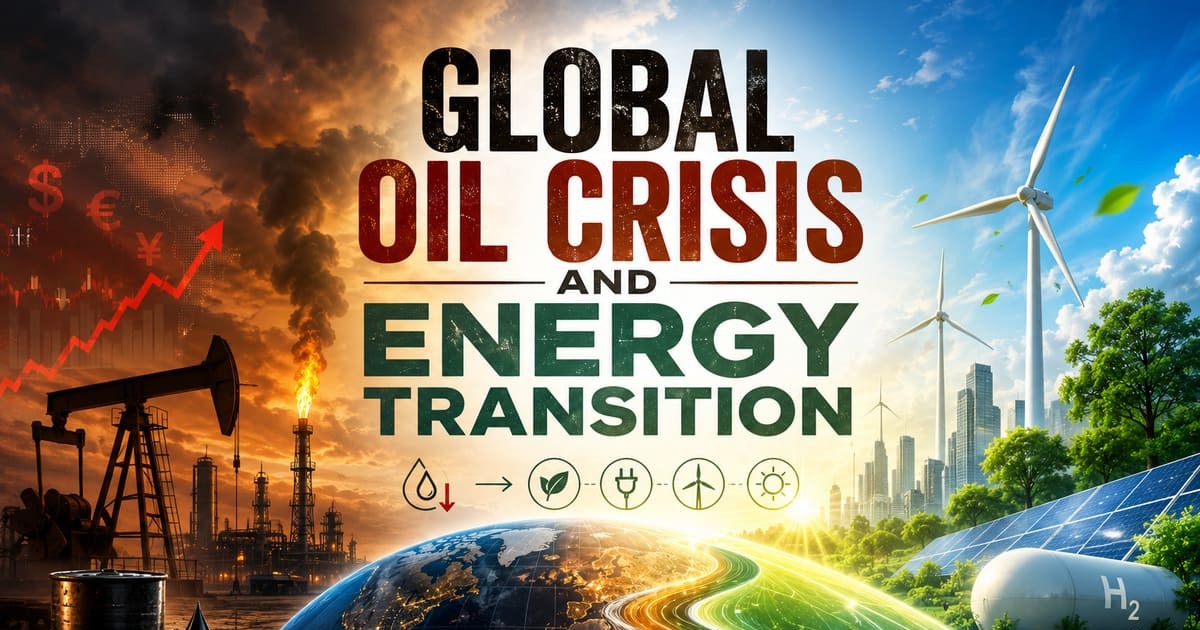
The Worldwide Oil Crisis
For over a century, crude oil has been the invisible engine of modern civilization. Today, that engine is sputtering. From supply chain fractures and price shocks to accelerating climate damage and finite reserve depletion, the global oil crisis is no longer a theoretical forecast—it’s a daily reality. Below is a comprehensive breakdown of the systemic problems, the policy interventions required, the viable energy alternatives, and the everyday actions that can collectively accelerate the transition.
1. The Problems We Face with Oil
Geopolitical Instability & Supply Weaponization: Over 60% of the world’s proven oil reserves are concentrated in politically volatile regions. Conflicts, sanctions, and strategic chokepoints like the Strait of Hormuz routinely trigger supply shocks, price spikes, and economic coercion that ripple across global trade, leaving importing nations vulnerable to external pressure.
Climate Acceleration & Ecological Damage: Oil combustion accounts for roughly one-third of global CO₂ emissions, while extraction processes like flaring, methane leaks, and deepwater drilling amplify environmental degradation. The resulting feedback loops—intensified wildfires, ocean acidification, and extreme weather—are already costing economies billions annually and displacing millions.
Economic Fragility & Inflationary Pressure: Oil prices are deeply embedded in the cost of transportation, agriculture, manufacturing, and plastics. Volatility in crude markets directly fuels inflation, strains emerging-market debt, and forces central banks into difficult monetary trade-offs that slow growth and increase household financial stress.
Declining EROI & Rising Extraction Costs: The era of easily accessible, high-yield oil is over. The Energy Return on Investment (EROI) has steadily declined, forcing companies into deeper offshore zones, Arctic regions, and complex shale formations. These projects demand more capital, consume vast water resources, and carry higher ecological and financial risks.
“The era of oil growth is ending. The energy transition is not just an environmental imperative—it’s an economic reality that will reshape global markets, trade routes, and geopolitical power structures.”
2. What Governments Must Take Action On
- Phase Out Fossil Fuel Subsidies & Redirect Capital: Governments currently spend over $7 trillion annually on direct and indirect fossil fuel subsidies (IMF). Phasing these out and reallocating funds toward grid modernization, renewable manufacturing, and worker retraining programs would accelerate deployment while ensuring a just transition for oil-dependent communities.
- Implement Transparent Carbon Pricing Mechanisms: Whether through cap-and-trade systems or escalating carbon taxes, putting a measurable cost on emissions forces corporations to internalize environmental damage. Revenue recycling into green infrastructure and household rebates prevents regressive economic impacts while driving rapid innovation.
- Modernize National Grids & Scale Energy Storage: Renewable sources require flexible, intelligent distribution networks. Governments must fund long-duration battery deployment, pumped hydro expansion, AI-driven demand-response systems, and cross-border interconnections to eliminate intermittency bottlenecks and phase out oil-fired peaker plants.
- Enforce Binding Climate Legislation & Accountability: Voluntary pledges are insufficient. Nations must embed Paris-aligned targets into law, establish independent climate oversight bodies, mandate corporate emissions disclosure, and tie public procurement to low-carbon standards to ensure measurable, enforceable progress.
“We cannot wait for tomorrow to act on today’s energy crisis. Policy leadership must be bold, inclusive, and anchored in science—not short-term political cycles. “
3. Future Energy Plans Instead of Oil
- Solar & Wind at Utility Scale: Next-generation photovoltaic cells and floating offshore wind farms now deliver levelized costs below new oil-fired generation in most regions. Coupled with automated tracking systems and improved turbine aerodynamics, these technologies are becoming the backbone of baseload renewable capacity.
- Green Hydrogen for Hard-to-Abate Sectors: Produced by splitting water using renewable electricity, green hydrogen is scaling rapidly for steelmaking, maritime shipping, chemical synthesis, and long-haul aviation. Pilot corridors and port infrastructure investments are already proving its commercial viability.
- Advanced Nuclear & Fusion Pathways: Small Modular Reactors (SMRs) offer factory-built, passively safe nuclear power with reduced waste profiles and faster deployment timelines. Meanwhile, experimental fusion projects are approaching net-energy milestones, promising virtually limitless, zero-carbon baseline power by the 2040s.
- Decentralized Microgrids & Peer-to-Peer Energy Trading: Community-scale renewable networks paired with smart meters and blockchain-enabled trading platforms allow neighborhoods to generate, store, and exchange power locally. This reduces transmission losses, enhances disaster resilience, and democratizes energy access.
“The message is clear: we need to plan for and accelerate the transition from fossil fuels to renewables. It is a fundamental shift that reshapes investment strategies globally, prioritizing energy security, affordability, and climate goals.”
4. What People Should Do to Reduce Oil Dependence
Rethink Daily Mobility Choices: Switching to electric vehicles, utilizing high-frequency public transit, carpooling, or adopting active transport (cycling/walking) for short trips can cut household oil demand by 30–50%. Supporting local infrastructure for bike lanes and EV charging multiplies this impact community-wide.
Optimize Home Energy Consumption: Upgrading to heat pumps, sealing air leaks, installing smart thermostats, and requesting energy audits can reduce residential fossil fuel reliance by 20–40%. Where available, opting into utility green tariffs or joining community solar programs directly displaces oil and gas generation.
Support Low-Oil Supply Chains & Circular Economies: Petroleum derivatives are embedded in plastics, synthetic fabrics, and packaged goods. Choosing durable, repairable, or biodegradable alternatives, reducing single-use consumption, and prioritizing locally sourced products shrinks upstream oil demand and waste.
Advocate, Vote, & Share Verified Information: Individual action scales through collective pressure. Voting for climate-forward candidates, joining energy cooperatives, demanding corporate transparency, and sharing peer-reviewed science helps shift public discourse and accelerates institutional change.
“You don’t need to be perfect to make a difference. Consistent, collective action is what shifts global systems, rewires markets, and secures a livable future.”
— Adapted from IPCC Climate Assessment Reports
The Final Word: Our Energy, Our Responsibility
The global oil crisis isn’t just an economic headline—it’s a defining inflection point for human civilization. Transitioning away from fossil fuels demands unprecedented cooperation, technological scaling, and individual accountability. But the infrastructure is maturing, the economics are decisively shifting, and the moral imperative is undeniable. The question is no longer if we can move beyond oil, but how swiftly we choose to act.
Share this article. Start conversations. Demand better policies. Choose clean energy today.