India Inaugurates World’s First Nuclear-Powered Hydrogen Production Facility
India achieves a historic milestone with the world's first hydrogen production facility powered by nuclear process heat at Kalpakkam. A comprehensive analysis of the technology, significance, and future implications.
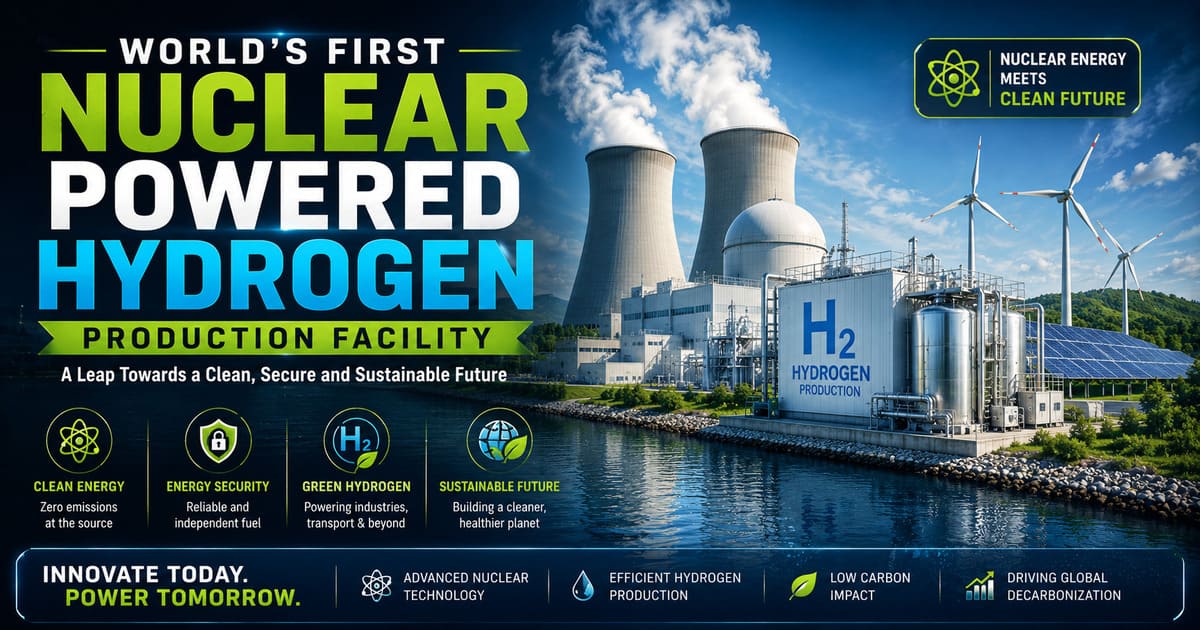
India Inaugurates World’s First Nuclear-Powered Hydrogen Production Facility
India has achieved a historic milestone in clean energy innovation with the inauguration of the world’s first hydrogen production facility that uses nuclear process heat. The pilot plant was commissioned on June 26, 2026, at the Indira Gandhi Centre for Atomic Research (IGCAR) in Kalpakkam, Tamil Nadu.
This breakthrough represents a significant step forward in the global transition toward sustainable energy systems. By successfully integrating nuclear energy with hydrogen production, India has demonstrated a pioneering technological capability that could reshape the future of clean energy worldwide.
1. Introduction: A New Dawn for Clean Energy
A Historic Moment at Kalpakkam
The Department of Atomic Energy (DAE) has established a facility that produces hydrogen using heat generated from the Fast Breeder Test Reactor (FBTR) at IGCAR, Kalpakkam. This is not just another research project; it is a fully operational technology demonstrator that validates a novel method of producing hydrogen without releasing greenhouse gases.
The facility was inaugurated by Dr. Ajit Kumar Mohanty, Secretary of the Department of Atomic Energy and Chairman of the Atomic Energy Commission (AEC), in the presence of Shri Sreekumar G. Pillai, Director of IGCAR.
In his address, Dr. Mohanty stated:
“The integration of nuclear energy with emerging clean energy technologies such as hydrogen production represents a strategic pathway towards a sustainable energy future. Nuclear power, with its unique ability to provide reliable carbon-free electricity as well as high-temperature process heat, is ideally suited to support large-scale hydrogen production while contributing to India’s energy security, decarbonisation goals and long-term sustainable development objectives.”
Why Hydrogen Matters
Hydrogen is widely regarded as a key energy carrier for the future and is expected to play a pivotal role in the global shift toward clean and sustainable energy systems. Unlike fossil fuels, hydrogen produces only water when used in fuel cells, making it an attractive solution for decarbonizing sectors that are difficult to electrify, such as heavy industry, shipping, and aviation.
However, the environmental benefits of hydrogen depend entirely on how it is produced. Currently, most hydrogen is produced from natural gas through a process called steam methane reforming, which releases significant amounts of carbon dioxide. The new facility at Kalpakkam offers a completely different approach—one that uses nuclear heat to split water into hydrogen and oxygen, emitting no greenhouse gases in the process.
2. Understanding Nuclear Hydrogen Production
The Science Behind the Process
The Copper-Chlorine (Cu-Cl) Thermochemical Cycle
The facility uses an innovative method called the Copper-Chlorine (Cu-Cl) thermochemical cycle, which was indigenously developed by the Bhabha Atomic Research Centre (BARC) in Mumbai. But what exactly does this mean?
In simple terms, a thermochemical cycle uses a series of chemical reactions to split water into hydrogen and oxygen. The Cu-Cl cycle consists of several steps that involve copper and chlorine compounds. The key feature is that the chemicals used in the process are recycled continuously, meaning they are not consumed and can be used again and again.
The Cu-Cl thermochemical cycle is considered one of the most promising hydrogen production technologies for several reasons:
- It requires relatively lower operating temperatures compared to other thermochemical cycles, making it compatible with nuclear reactors
- It offers higher thermodynamic efficiency, meaning more hydrogen is produced with less energy input
- The chemicals involved are readily available and can be recovered and reused, making the process sustainable and cost-effective
How Nuclear Heat Replaces Fossil Fuels
The facility harnesses nuclear process heat generated from the Fast Breeder Test Reactor (FBTR) at Kalpakkam. Instead of burning fossil fuels to generate heat for hydrogen production, the facility uses the high-temperature heat produced by the nuclear reactor.
This approach offers several advantages:
- Zero greenhouse gas emissions – The process produces clean hydrogen without releasing carbon dioxide
- Reduced dependence on fossil fuels – Nuclear energy provides a reliable and abundant source of heat
- Energy security – Countries with nuclear capabilities can produce hydrogen domestically without relying on imported fossil fuels
The Fast Breeder Test Reactor (FBTR)
The FBTR is India’s only operating fast reactor research facility and has been an invaluable platform for nuclear research for more than four decades. It was designed, constructed, and operated by IGCAR, which has been at the forefront of India’s Fast Breeder Reactor programme since its establishment in 1971.
The FBTR has served as a testbed for developing and validating:
- Nuclear fuels
- Advanced materials
- Sodium technologies
The knowledge and expertise gained through the FBTR have laid the technological foundation for India’s fast reactor programme and played a pivotal role in the development of the 500 MWe Prototype Fast Breeder Reactor (PFBR) , the flagship of the second stage of India’s three-stage nuclear power programme.
Key Insight: The PFBR, also located at Kalpakkam, achieved first criticality on April 6, 2026—just months before the hydrogen facility was inaugurated. This demonstrates India’s rapid progress in advanced nuclear technologies.
3. India’s Three-Stage Nuclear Programme
To fully appreciate the significance of this achievement, it is essential to understand India’s unique nuclear strategy.
India has a three-stage nuclear power programme designed to utilize its vast thorium reserves and achieve long-term energy self-sufficiency. The three stages are:
| Stage | Reactor Type | Fuel Used | Objective |
|---|---|---|---|
| Stage I | Pressurised Heavy Water Reactors (PHWRs) | Natural Uranium | Produce plutonium |
| Stage II | Fast Breeder Reactors (FBRs) | Plutonium + Uranium-238 | Breed more fissile material than consumed |
| Stage III | Advanced Heavy Water Reactors (AHWRs) | Thorium + Uranium-233 | Utilize India’s abundant thorium reserves |
The Role of Fast Breeder Reactors
Fast Breeder Reactors are central to India’s long-term nuclear strategy. Unlike conventional thermal reactors, fast reactors:
- Use mixed oxide fuel containing plutonium and uranium
- Produce more fissile material than they consume
- Generate Uranium-233, enabling the future use of thorium in the third stage of the nuclear programme
The Prototype Fast Breeder Reactor (PFBR), which achieved criticality earlier this year, represents a major step forward in India’s nuclear capabilities. The PFBR is a 500 MWe reactor that was indigenously designed and developed by IGCAR.
Extending Nuclear Power Beyond Electricity
The hydrogen production facility at Kalpakkam represents a significant extension of India’s nuclear programme. Traditionally, nuclear energy has been used primarily for electricity generation. This new facility demonstrates that nuclear power can also be used for non-electric applications, such as producing hydrogen for industrial use.
Shri Sreekumar G. Pillai, Director of IGCAR, emphasized this point:
“This achievement builds upon more than four decades of operational experience and technological excellence gained through the Fast Breeder Test Reactor programme at IGCAR. The successful demonstration of hydrogen production using nuclear process heat showcases the versatility of advanced nuclear systems and underscores IGCAR’s commitment to developing innovative technologies that contribute to India’s clean energy transition and long-term energy security.”
4. The Technology Behind the Facility
The Copper-Chlorine Thermochemical Cycle in Detail
The Cu-Cl cycle is a closed-loop process that requires copper and chlorine compounds as intermediate materials. Here’s a simplified overview of how it works:
- Hydrolysis: Copper chloride reacts with steam at high temperatures to produce copper oxychloride and hydrogen chloride
- Oxygen Production: Copper oxychloride decomposes at higher temperatures to release oxygen and regenerate copper chloride
- Hydrogen Production: Hydrogen chloride reacts with copper in an electrochemical step to produce hydrogen and regenerate copper chloride
The beauty of this cycle is that the copper and chlorine compounds are recovered and reused, making the process highly efficient and cost-effective.
Why the Cu-Cl Cycle Was Chosen
Among the various hydrogen production technologies being developed worldwide, the Cu-Cl cycle stands out because of its:
- Relatively lower operating temperatures (compared to other thermochemical cycles)
- Higher thermodynamic efficiency
- Compatibility with nuclear reactors (the temperatures required are achievable with advanced reactors)
The Role of BARC and IGCAR
The facility represents the culmination of extensive research, process development, engineering design, equipment fabrication, installation, testing, and commissioning efforts undertaken jointly by BARC and IGCAR.
- BARC developed the Cu-Cl thermochemical process indigenously
- IGCAR provided the nuclear infrastructure and operational expertise
This collaboration between two of India’s premier nuclear research institutions demonstrates the power of indigenous innovation and institutional synergy.
5. Environmental and Economic Benefits
Eliminating Greenhouse Gas Emissions
Traditional hydrogen production methods, such as steam methane reforming, release approximately 10-12 tonnes of CO₂ for every tonne of hydrogen produced. By harnessing nuclear heat from fast reactors, the Kalpakkam facility significantly reduces dependence on fossil fuels and eliminates greenhouse gas emissions associated with conventional hydrogen production methods.
This aligns with India’s commitment to achieving net-zero emissions and building a low-carbon energy future.
Potential for Large-Scale Commercial Deployment
The current facility is a technology demonstrator, meaning it is designed to prove that the technology works at a practical scale. The plant will provide:
- Valuable operational experience
- Data for further optimization of the Cu-Cl process
- Insights for scaling up nuclear-assisted hydrogen production technologies for commercial deployment
The success of this pilot plant could pave the way for large-scale, carbon-free hydrogen production using advanced nuclear reactors, not just in India but around the world.
Contribution to India’s Energy Security
India currently imports significant quantities of oil and gas to meet its energy needs. By producing hydrogen domestically using nuclear energy, India can:
- Reduce its dependence on imported fossil fuels
- Enhance its energy security
- Strengthen its technological self-reliance (AtmaNirbhar Bharat)
Supporting Viksit Bharat
The inauguration of the facility marks a major step toward realizing the vision of AtmaNirbhar Bharat (Self-Reliant India) through the convergence of nuclear energy and clean hydrogen technologies. It demonstrates DAE’s continued commitment to indigenous innovation and reinforces India’s resolve to build a sustainable, secure, and low-carbon energy future for Viksit Bharat (Developed India).
6. Key Stakeholders and Their Roles
Department of Atomic Energy (DAE)
The DAE is the government body responsible for all nuclear activities in India. It oversees:
- Research and development
- Nuclear power generation
- Non-electric applications of nuclear energy
The DAE provided the policy framework and institutional support for the project.
Indira Gandhi Centre for Atomic Research (IGCAR)
IGCAR, located in Kalpakkam, is one of India’s premier nuclear research institutions. Since its establishment in 1971, IGCAR has been at the forefront of the country’s Fast Breeder Reactor programme. Its contributions include:
- Designing, constructing, and operating the FBTR
- Developing advanced materials and sodium technologies
- Providing the nuclear heat source for hydrogen production
IGCAR has established internationally recognised capabilities in:
- Reactor physics
- Thermal hydraulics
- Advanced materials
- Sodium technology
- Fuel cycle research
- Instrumentation and control systems
- Remote handling
- Non-destructive evaluation
- High-temperature engineering
Bhabha Atomic Research Centre (BARC)
BARC, based in Mumbai, is India’s premier nuclear research facility. It:
- Indigenously developed the Cu-Cl thermochemical process
- Provided the chemical engineering expertise for the facility
- Collaborated with IGCAR on the project
Global Leadership
This achievement reinforces India’s position among the global leaders in advanced nuclear technologies and clean energy systems. According to IGCAR, the successful integration of nuclear process heat with hydrogen generation:
- Marks a pioneering technological breakthrough
- Opens a promising pathway for large-scale, carbon-free hydrogen production
7. What This Means for the Future
A New Era of Clean Energy
The Kalpakkam facility represents a significant leap forward in clean energy innovation. It demonstrates that nuclear energy can be used not just to generate electricity, but also to produce hydrogen—a fuel that could help decarbonize sectors that are difficult to electrify, including:
- Heavy industry (steel, cement, chemicals)
- Shipping
- Aviation
- Long-distance transportation
Global Implications
While this is an Indian achievement, its implications are global. India has:
- Demonstrated a technology that could be replicated in other countries with nuclear capabilities
- Contributed to the global knowledge base on thermochemical hydrogen production
- Shown that nuclear energy can play a key role in the global transition to clean energy
India’s Hydrogen Strategy
India has set ambitious targets for hydrogen production under its National Hydrogen Mission. The Kalpakkam facility supports this mission by:
- Providing a viable pathway for green hydrogen production
- Reducing dependence on imported fossil fuels for hydrogen production
- Enhancing India’s energy security and technological self-reliance
Future Research and Development
The plant will support future research aimed at:
- Scaling up nuclear-assisted hydrogen production technologies
- Optimizing the Cu-Cl process for commercial deployment
- Exploring other non-electric applications of nuclear energy
Support for India’s Decarbonisation Goals
India has committed to achieving net-zero emissions by 2070. The Kalpakkam facility contributes to this goal by:
- Demonstrating a technology for carbon-free hydrogen production
- Reducing dependence on fossil fuels
- Supporting the development of a hydrogen economy in India
8. Frequently Asked Questions
Q1: What is the facility and where is it located?
A: The facility is the world’s first hydrogen production plant that uses nuclear process heat. It is located at the Indira Gandhi Centre for Atomic Research (IGCAR) in Kalpakkam, Tamil Nadu.
Q2: What is the technology used?
A: The facility uses the Copper-Chlorine (Cu-Cl) thermochemical cycle, which was indigenously developed by the Bhabha Atomic Research Centre (BARC), Mumbai.
Q3: What is the source of heat?
A: The facility uses nuclear process heat generated from the Fast Breeder Test Reactor (FBTR) at IGCAR.
Q4: Why is this significant?
A: This is the world’s first facility to produce hydrogen using nuclear heat. It demonstrates a pathway for large-scale, carbon-free hydrogen production, which can help reduce greenhouse gas emissions and dependence on fossil fuels.
Q5: What is the role of BARC and IGCAR?
A: BARC developed the Cu-Cl thermochemical process, while IGCAR provided the nuclear infrastructure and operational expertise. Both institutions collaborated on the project.
Q6: Is this facility commercially operational?
A: It is a technology demonstrator, designed to validate the technology and provide data for future commercial deployment.
Q7: What is the environmental benefit?
A: The process eliminates greenhouse gas emissions associated with conventional hydrogen production methods, which release 10-12 tonnes of CO₂ per tonne of hydrogen produced.
Q8: How does this fit into India’s nuclear programme?
A: It extends the role of nuclear power beyond electricity generation into large-scale, carbon-free hydrogen production, strengthening India’s three-stage nuclear programme.
Q9: What is the PFBR?
A: The Prototype Fast Breeder Reactor (PFBR) is a 500 MWe reactor at Kalpakkam, indigenously designed and developed by IGCAR. It is the flagship of the second stage of India’s three-stage nuclear programme.
Q10: What is AtmaNirbhar Bharat?
A: AtmaNirbhar Bharat is India’s vision of self-reliance, particularly in critical technologies. The facility demonstrates this vision through indigenous innovation in nuclear energy and clean hydrogen technologies.
9. Conclusion
India’s inauguration of the world’s first hydrogen production facility using nuclear process heat is a landmark achievement in clean energy innovation. It demonstrates:
- India’s technological prowess in advanced nuclear systems
- The potential of nuclear energy for non-electric applications
- A pathway for large-scale, carbon-free hydrogen production
The facility at Kalpakkam represents the culmination of decades of research and development, building on more than 40 years of operational experience gained through the Fast Breeder Test Reactor programme. It showcases the successful collaboration between BARC and IGCAR and reinforces India’s position among the global leaders in advanced nuclear technologies and clean energy systems.
As the world transitions toward sustainable energy systems, this pioneering facility in Tamil Nadu offers a promising model for clean hydrogen production—one that could be replicated across the globe to reduce emissions, enhance energy security, and build a sustainable future.
As Dr. Ajit Kumar Mohanty stated:
“This achievement is a testament to India’s growing capabilities in advanced nuclear technologies and clean energy systems.”
10. Further Reading & External Resources
| Resource | Description |
|---|---|
| Department of Atomic Energy (DAE) | Official website of India’s Department of Atomic Energy |
| Bhabha Atomic Research Centre (BARC) | Information on India’s premier nuclear research facility |
| Indira Gandhi Centre for Atomic Research (IGCAR) | Details on India’s fast breeder reactor programme |
| Prototype Fast Breeder Reactor (PFBR) | Information on India’s 500 MWe fast breeder reactor |
| Thermochemical Hydrogen Production | U.S. Department of Energy resource on thermochemical cycles |
| Clean Energy Ministerial | International forum for clean energy collaboration |
| World Nuclear Association | Global information on nuclear energy applications |
| International Atomic Energy Agency (IAEA) | United Nations agency for nuclear cooperation |
Disclaimer: This article is intended for informational purposes only. The information presented has been sourced from publicly available materials and news reports. While every effort has been made to ensure accuracy, readers are encouraged to verify facts with official sources.