The Broken Chain: How a Bicycle, a Lorry, and Bangalore Taught Me About Peace
I was twenty-two, alone in a city that wanted to burn. My bicycle chain snapped at 6 AM. By noon, I was running for my life. This is what a riot taught me about being human.
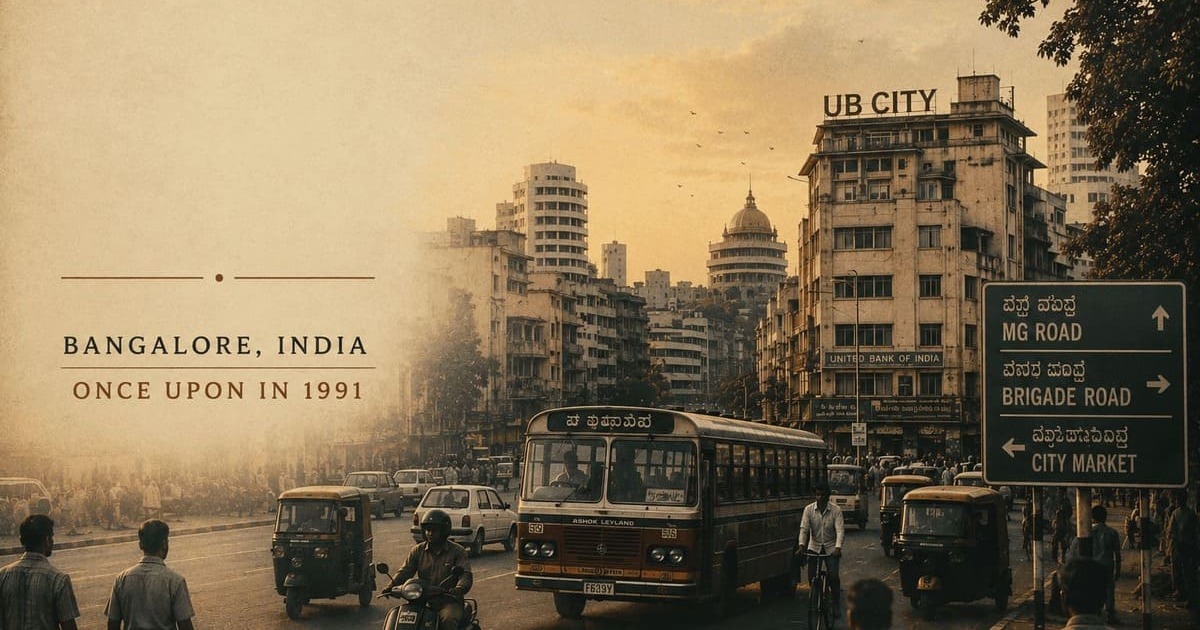
[A note to the reader: This story happened in December 1991. I was twenty-two years old. I have written it exactly as I remember—the fear, the confusion, and the strange kindness that saved me. Some names have been changed to protect the privacy of those who helped. The lessons, however, remain unchanged.]
Part One: The Bicycle and the City That Wasn’t Mine
Bangalore, 1991, was not the Bangalore you know today.
There were no glass towers. No tech parks. No coffee shops named after Norwegian ski resorts. It was a city of pensioners, public sector factories, and the slow, gentle rustle of kannada in the morning air. I had arrived three months earlier, clutching a diploma and a foolish ambition to “make it” in the city of gardens.
I did not speak Kannada.
I told myself it did not matter. English worked in offices. Hindi worked in markets. Tamil—my mother tongue—worked in the slums where I rented a room the size of a prison cell. “I will learn,” I kept saying. “Next week. Next month.” Next never came.
On the morning of December 12, 1991, I woke up before the sun. I had a job interview at 9 AM—a small printing press near Majestic bus station. My bicycle was my only fortune: a rusted Hero bicycle with brakes that squealed like dying birds and a chain that had been held together by prayer for six months.
I pedaled through Seshadripuram. The streets were unusually quiet. No newspaper vendors. No morning tea stalls. Just the wet smell of overnight rain and the distant sound of a loudspeaker crackling somewhere I could not see.
At 6:15 AM, my bicycle chain snapped.
I remember the exact moment because I cursed. Loudly. In Tamil. A long, creative string of curses that would have made my mother wash my mouth with soap. I got off, squatted on the pavement, and stared at the broken metal in my hands.
“Of all mornings,” I muttered.
An old Kannadiga gentleman, walking his dog, stopped. He looked at my bicycle. He looked at my face. He said something in Kannada I did not understand.
I shrugged. “Gothilla,” I said. I don’t know. It was the only Kannada word I had bothered to learn.
He smiled—not unkindly—and walked away. I watched him go and felt something I had never felt before in Bangalore. A small, cold ache. I should have learned. I should have tried.
I left the bicycle against a gulmohar tree and decided to walk.
Part Two: The Sky Turned Black
By 8 AM, I knew something was wrong.
The streets that should have been flooded with office-goers were empty. Shutters were down. A BMTC bus stood abandoned in the middle of the road, its windows shattered, its seats smoking. And then I saw the first mob.
They were young. My age. Some younger. Their faces were not angry—that was what terrified me. They were celebrating. One man swung a lathi like a flag. Another kicked a motorcycle with a Tamil Nadu license plate until it fell over like a dead animal.
I did not understand what was happening.
I ran.
What I learned later: The Cauvery water dispute had boiled over. The day before—December 11, 1991—the government had officially notified a tribunal award ordering Karnataka to release water to Tamil Nadu [citation:5]. For pro-Kannada groups, this was not politics. This was theft. “Cauvery is the mother of the Kannadigas,” their leader had declared. “We cannot give water to anybody else.” [citation:5]
By December 13, mobs roamed Bangalore’s streets targeting Tamil businesses, Tamil vehicles, Tamil faces [citation:5]. Official figures said sixteen people died. Individual accounts said more [citation:5].
But standing on Residency Road that morning, I did not know any of this. I only knew that a man was screaming in Kannada, pointing at me, and ten others were starting to run in my direction.
Part Three: The Lorry Driver
I do not remember which street I turned into. Somewhere near Richmond Town, I think. My lungs were burning. My shoes—cheap Bata sandals—had lost one strap.
And then I saw the lorry.
It was a rusty Tata truck, the kind that carries vegetables from K.R. Market. Its engine was running. Its driver—a large man with a gamchha around his neck—was looking at me through the side mirror.
I did not think. I ran to the passenger door and banged my fist against it.
“Please,” I said in Hindi. “Please. They are chasing me.”
He looked at me. He looked behind me at the mob now turning the corner. He said one word in Kannada. I did not understand it.
Then he leaned over and opened the door.
I climbed in. He shifted gears. The lorry lurched forward. The mob threw a stone that hit the tailgate with a sound like a gunshot. And then we were gone.
For the next hour, I sat in silence as the lorry wound its way through back roads I had never seen. The driver did not speak. He did not look at me. He just drove—past burning vehicles, past police barricades, past a woman sitting on the pavement holding a child and crying.
Finally, near Electronic City—which was not Electronic City yet, just empty land and a few factories—he stopped the lorry.
“Where you go?” he asked in broken Hindi.
“Tamil Nadu border,” I said. “Anywhere. My home is near Madurai.”
He nodded. He pulled out a parle-g biscuit packet from his dashboard, broke it into two halves, and gave me one.
“Eat,” he said.
I ate. And then—I do not know why—I started crying. Not loud sobs. Just tears. The kind that come when your body finally realizes it almost died.
He did not say anything. He did not pat my back or offer empty comfort. He just sat there, eating his half of the biscuit, watching the empty road ahead.
After five minutes, he started the engine again.
“I take you to Hosur,” he said. “From there, you find bus. Okay?”
“Okay,” I said.
He drove me to the border. I got out. I tried to give him money—all the money I had, which was not much. He refused.
“You are my brother,” he said. “Brothers do not pay.”
He did not ask my name. He did not tell me his. He just turned the lorry around and drove back into the city that was burning.
I never saw him again.
Part Four: What the Broken Chain Taught Me
That night, sitting in my mother’s kitchen in my village, drinking hot filter coffee, I could not stop thinking.
Not about the mob. Not about the fear.
About the old man with the dog. About the lorry driver who shared his biscuit. About the Kannadiga who did not speak my language but opened his door anyway.
I had spent three months in Bangalore refusing to learn Kannada. I had told myself it was not necessary. I had walked through that city like a ghost, invisible and willfully ignorant. And then, when the city turned violent, it was a Kannadiga—a man whose language I had dismissed—who saved my life.
The lesson was not complicated. Violence is not the solution. But neither is isolation. Neither is the arrogant assumption that the world will accommodate you without you accommodating it back.
Mahatma Gandhi once walked through the violence of Noakhali in 1946, trying to stop Hindu-Muslim riots. He said something that stayed with me:
“I have come to stay here with you as one of you. I claim to be an Indian and therefore a Bengali even as I am a Gujarati.” [citation:9]
He was saying: You are not a visitor. You are not a stranger. You are family. Act like it.
I had not acted like family in Bangalore. I had acted like a tenant. And in doing so, I had made myself vulnerable to a violence that fed on the distance between us.
Part Five: A Solution for Political Violence
You cannot legislate love. You cannot police kindness. But you can build the conditions where violence becomes unthinkable.
Here is what I learned from a broken bicycle chain and a lorry driver’s biscuit:
1. Learn the Language. Even the Basics.
I am not saying you must become a poet in every language of every city you visit. But learn something. “Good morning.” “Thank you.” “Where is the hospital?” These are not words. They are bridges.
In the 1991 anti-Tamil violence, many Tamil families who had lived in Bangalore for generations still did not speak Kannada [citation:7]. They had built walls around themselves—comfortable, familiar, dangerous walls. When the mob came, those walls became targets.
“We are Tamil-speaking,” one resident told a reporter years later, “but Karnataka is like our mother.” [citation:7]
A mother deserves to be spoken to in her own language.
2. Recognize That Water and Bread Are Not Metaphors
The Cauvery water dispute is real. Farmers on both sides of the border watch their fields dry while politicians shout. The violence of 1991 did not emerge from nowhere. It emerged from hunger, from fear, from the desperate belief that if they get water, we will die.
You cannot solve political violence without solving political problems. Acharya Lokesh, who founded India’s first World Peace Centre in Gurugram, puts it simply:
“We are seeing wars going on in many parts of the world. Even after the war, they come to the negotiating table. So why not come to the table earlier?” [citation:4]
Negotiate before the chain breaks. Share the water before the mob gathers. Prevent, do not repair.
3. See the Individual, Not the Category
The mob saw my Tamil face and decided I was the enemy. The lorry driver saw a scared young man and decided I was his brother.
The difference between violence and peace is that simple. It is not about ideology. It is about eyes. Do you see a person or a label?
The ancient Indian philosophy of Vasudhaiva Kutumbakam—”the world is one family”—is not a slogan. It is a practice. It means refusing to let categories (language, religion, state, party) blind you to the human being standing in front of you.
4. Learn Your Own History
I did not know about the Cauvery dispute. I did not know about the 1965 anti-Hindi agitations [citation:8]. I did not know that my own Tamil community had, at different times, been both the oppressed and—let us be honest—the perceived oppressor.
Ignorance is not innocence. Ignorance is a choice. And when you choose ignorance, you hand the mob its weapon.
5. If You Can, Be the Lorry Driver
You may never be a politician. You may never negotiate a river treaty. But you can be the person who opens the door when someone is running.
That lorry driver did not solve the Cauvery dispute. He did not end communalism. He did not even ask my name. But he saved one life. And one life is where peace always begins—not with grand gestures, but with a half-shared biscuit.
Epilogue: The Bicycle Chain, Replaced
I went back to Bangalore six months later.
The city had healed. The scars remained—burned shops, empty lots where slums had stood, families who never returned [citation:7]. But the Kannada flags still flew. The tea stalls still served chai in tiny glasses. Life had resumed its ordinary, stubborn rhythm.
I found my bicycle exactly where I had left it. The rusted Hero, still leaning against the gulmohar tree. The chain was still broken.
I walked it to a repair shop on Commercial Street. The mechanic—a cheerful Kannadiga with grease on his fingers—looked at the chain and whistled.
“You are lucky,” he said in Kannada. “This could have snapped in traffic. You could have died.”
I understood him. Not every word. But enough.
“Dhanyavada,” I said. Thank you.
He looked up, surprised. Then he smiled.
“Swalpa swalpa,” he said. Little by little. Your Kannada is improving.
I smiled back. “Swalpa swalpa,” I repeated.
He fixed the chain in five minutes. I paid him. I rode away.
And for the first time since I had arrived in Bangalore, I did not feel like a stranger.
“Peace is not the absence of conflict. It is the presence of justice and the practice of seeing your own face in every other face.”
This story is dedicated to the lorry driver whose name I never learned. If you are reading this, sir: your biscuit saved more than my life. It saved my faith.
— The Traveler
Bangalore, 1991 / Written, 2026