Unique Traditions Around the World: An Anthropological Journey
An anthropological journey into human diversity — rituals that define us, celebrate life, and reveal our shared soul.
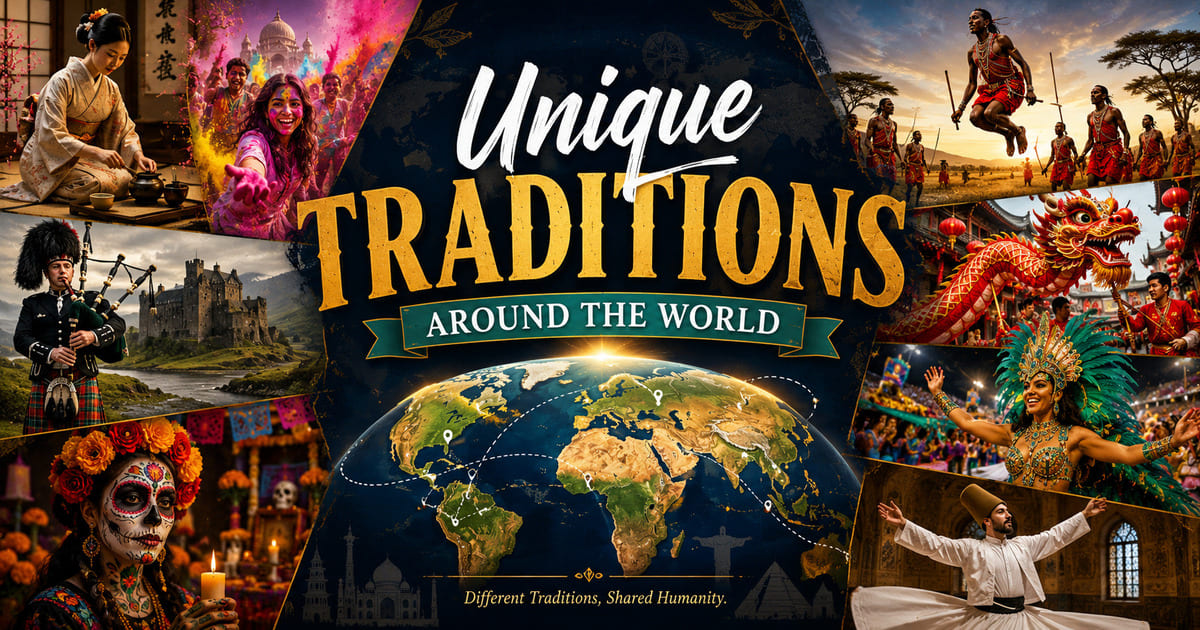
An Anthropological Journey Into Human Diversity — Rituals that define us, celebrate life, and reveal our shared soul.
From the high plateaus of Papua to the misty cemeteries of Madagascar, humanity paints its existence with astonishing customs. Anthropologists argue that tradition is the architecture of identity. In this journey, we explore rituals that might seem strange at first glance — but each embodies deep wisdom, belonging, and the brilliant spectrum of human diversity.
“The world is a book, and those who do not travel read only a page.”
— Saint Augustine of Hippo
Famadihana · The Turning of the Bones
Madagascar · A celebration of ancestral connection
In Madagascar, the Famadihana ceremony is known as the “dancing with the dead.” Every five to seven years, families exhume their deceased loved ones, rewrap them in fresh silk shrouds, and dance joyfully with the remains. Far from being macabre, this ritual honors ancestors and accelerates their passage into the afterlife. It strengthens family bonds and reaffirms the cyclical nature of life.
- Ritual features: music, live brass bands, joyful dancing, rewrapping ancestors with fresh cloth.
- Anthropological meaning: Death is not an end but a transition; ancestors remain social members.
- Modern challenges: Rising costs of silk and Christian influences shape the practice.
El Colacho · The Baby Jumping Festival
Castrillo de Murcia, Spain · A cleansing leap of faith
For over 400 years, the Spanish village celebrates El Colacho — where men dressed as devils (Colacho) jump over rows of newborn babies lying on mattresses in the street. This unusual tradition, part of the Catholic feast of Corpus Christi, is believed to wash away original sin and protect infants from evil spirits. The Church has historically criticized it, but locals preserve it as an emblem of identity.
- Key elements: colorfully costumed “devils,” whips, drumming, and babies placed on cushions.
- Symbolism: triumph of good over evil, community protection, fertility blessing.
- Safety note: modern precautions ensure infants are never harmed; a rapid jump across.
“We are not separate from the web of life; we are the web — our rituals are the strands that hold meaning together.”
— Wade Davis, Canadian Anthropologist & Ethnobotanist
Ikipalin · Finger Cutting Among the Dani
West Papua, Indonesia · Grief carved in flesh
Among the Dani people of the highlands, the ritual of Ikipalin involves amputating a woman’s upper finger joint upon the death of a close family member. Practiced to express deep sorrow and ward off evil spirits, it also symbolizes the severing of the emotional bond with the deceased. While Indonesian government and missionaries have discouraged it, elderly women still bear the scars — living memory of ancestral grief.
- Features: traditional stone tools, rituals led by elders, scars as visual mourning.
- Transition: younger generations adopt symbolic mourning instead of amputation.
- Ethical lens: Anthropologists debate cultural relativism vs. human rights.
Polterabend · The German Shard Wedding
Germany & parts of Central Europe · smash for good luck
The night before a German wedding, guests gather for Polterabend — smashing porcelain and ceramics (never glassware, because that brings bad luck). The loud shattering is said to drive away evil spirits, and the broken pieces symbolize that the couple can overcome any hardship together. The couple then cleans up the shards together, a metaphor for teamwork. An ancient custom revived with modern joy.
- Practice: friends bring old plates, bowls, flower pots; no mirrors (superstition!).
- Cultural twist: often includes bonfire, snacks, laughter — loud and boisterous.
- Regional variant: similar rituals in Austria, Switzerland.
“Never doubt that a small group of thoughtful, committed citizens can change the world; indeed, it’s the only thing that ever has. Traditions remind us of that collective power.”
— Margaret Mead, Cultural Anthropologist
La S · Whistling Traditions of the Hani People
Yunnan, China & Northern Laos · Amorous airs
Among the Hani ethnic minority, young men and women communicate romantic interest through a language of whistled melodies. This “whistled speech” can imitate tones of the Hani language and convey secret messages across rice terraces. The tradition La S avoids parental interference and is considered elegant, poetic, and discreet. UNESCO highlights it as intangible cultural heritage.
- Key aspects: lip-vibrated melodies, call-and-response, moonlight courtship.
- Social function: strengthens group endogamy and flirting etiquette.
- Endangerment: modern technology reduces oral transmission; preservation projects ongoing.
Why Traditions Define Human Diversity
From the Viking funerals to the Cherokee Green Corn Ceremony, every custom reflects adaptation to environment, spiritual beliefs, and collective memory. Anthropologically, rituals reduce anxiety about uncontrollable events (death, harvest, marriage) and forge solidarity. The more we study ‘strange’ customs, the more we discover our common humanity: the need to celebrate, to mourn, and to connect.
Anthropologist’s Reflection: Cultural Relativism in Action
“Each tradition is a solution to a universal human problem. When we pause judgement, we unlock empathy.” — Clifford Geertz (interpretive anthropology). Practices like Famadihana or Ikipalin teach us that human meaning is diverse and resilient. The goal of this journey is not to rank but to listen.
Tarantism · The Dancing Plague of Southern Italy
Apulia, Italy · music as exorcism & healing
Legend holds that the bite of the tarantula wolf spider would cause a mysterious hysteria — tarantism. The cure? ecstatic, frenzied dancing to the rhythm of tambourines and fiddles. Tarantism evolved into a musical tradition (pizzica tarantata) that blends folk Catholicism with ancient Dionysian rites. Today, it’s a cultural festival where people ‘dance away’ psychological burdens.
- Healing process: dancers mimic spider movements, wear colorful costumes, collapse in trance.
- Modern resurrection: annual “Notte della Taranta” attracts thousands.
- Psychosocial interpretation: symbolic release of social repression.
“Ritual is the passage that transforms the anonymous crowd into a community of memory. Across cultures, we beat the same heart.”
— David Graeber, Anthropologist & Author of “Debt: The First 5,000 Years”
Further Reading & External Explorations
Deepen your anthropological journey by visiting these rich resources:
- Ritual on Wikipedia – the science and symbolism of rites.
- SAPIENS.org – anthropology magazine with living traditions.
- UNESCO Intangible Cultural Heritage List – safeguarding global traditions.
- Britannica: Festivals & Rituals – encyclopedic overview.
Every tradition — joyful, bizarre, or solemn — is an evolving story. The next time you hear of a far-flung custom, remember that inside every ritual lives a family, a village, and a heartbeat that echoes through centuries.
| **Anthropological Journey | Unique Traditions Around the World** — originally published for curious minds. Celebrate human diversity with respect and wonder. |
Written in the spirit of cross-cultural dialogue. All external links lead to reputable references like Wikipedia, Britannica, and scholarly sources.