Gentle Reminder to the Honourable Prime Minister of India
A sincere appeal from the soil of India, the farmers of India, and the conscience of a billion citizens regarding the National River Interlinking Project.
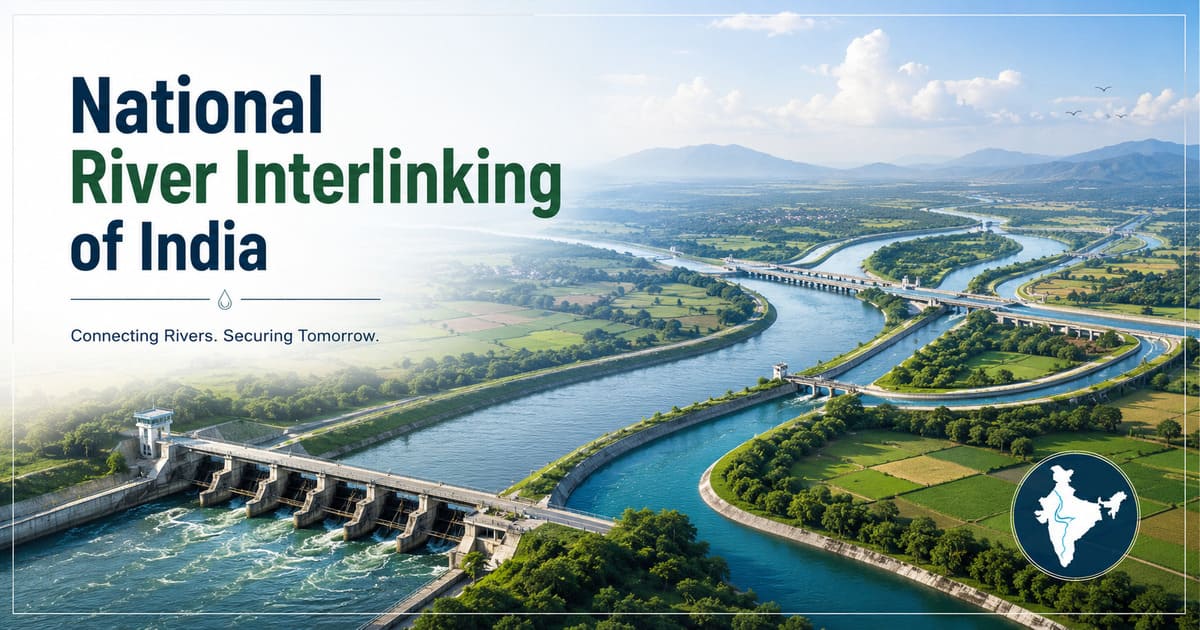
A sincere appeal from the soil of India, the farmers of India, and the conscience of a billion citizens.
Respected Honourable Prime Minister Shri Narendra Modi Ji,
I write this not as a critic, not as an opposition voice, but as an ordinary Indian citizen — one who wakes up every morning to the news of water tankers in one state, floods in another, and farmers committing suicide in a third. I write as someone who believes in democracy, respects your office, and loves this nation with every fibre of my being.
For decades, the rivers of India have not just carried water — they have carried the weight of our disputes. The Cauvery water conflict between Karnataka and Tamil Nadu is not merely a legal or administrative issue; it is an emotional wound that reopens every summer. Brothers from one state accuse brothers from another of stealing their livelihood. Farmers on both sides of the border shed tears — not because they hate each other, but because they are thirsty, because their lands are cracking, because their children are migrating.
Honourable Prime Minister, the National River Interlinking Project (NRLP) was once dreamt of as India’s grandest infrastructure mission — a vision that would make water scarcity a relic of the past. It was discussed decades ago. Promises were made. Hopes were raised. But today, even after thirty years of liberalisation, seventy-five years of independence, and nearly a decade of your transformative leadership, we are still waiting.
This is not an accusation. This is a gentle reminder. A reminder from the people who elected you, who trust you, and who believe that if any government can unite India’s rivers, it is yours.
“Water is the driving force of all nature.”
— Leonardo da Vinci — Read more on water philosophy
Importance of National River Interlinking: Why This is India’s Most Crucial Unfinished Mission
1. Equal Distribution of Water Resources – India’s Unfinished Geography
India receives enough rainfall to meet its needs — but it falls in just 100 hours a year, and mostly in the northeast and the western ghats. By 2030, NITI Aayog’s Composite Water Management Index report warns that 40% of India’s population will have no access to drinking water. The report also states that 21 major cities — including Delhi, Bengaluru, Chennai, and Hyderabad — will run out of groundwater by 2030, affecting 100 million people. The National River Interlinking Project is not a luxury — it is a mathematical necessity.
2. Reducing Floods and Droughts Simultaneously
Every year, we mourn. In Assam and Bihar, floods drown villages. In Maharashtra and Tamil Nadu, droughts crack the earth. Ironically, the same monsoon that destroys one state bypasses another. River interlinking allows us to capture excess floodwater in reservoirs and transfer it to rain-deficient regions. It turns a disaster into a resource. Why should a farmer in Bengal watch his home wash away while a farmer in Telangana watches his crop burn?
| Statistic | Impact |
|---|---|
| 300,000+ | Farmers lost since 1990s |
| 35 Mha | Additional irrigation potential |
| 34,000 MW | Potential hydropower |
3. Preventing Farmer Suicides – A Moral Imperative
Sir, over 300,000 Indian farmers have ended their lives since the 1990s. One of the most cited reasons is crop failure due to erratic or absent water. A farmer does not need a loan waiver alone — he needs water. He needs certainty. He needs to know that his labour will not turn to dust. River interlinking can stabilise irrigation across 35 million hectares of farmland. It will not solve everything, but it will remove the single greatest variable that pushes a farmer to despair: the monsoon’s cruelty.
4. Recharging Groundwater – India’s Invisible Crisis
We are drinking our future. In Punjab, Haryana, Rajasthan, and Tamil Nadu, groundwater tables are falling by over one metre every year. Once gone, it takes centuries to recharge. Interlinking rivers will not only provide surface water but will also allow managed aquifer recharge. More water in canals means more percolation. Safer wells mean rural families staying in their villages instead of migrating to slums.
5. National Unity Through Water
When Karnataka and Tamil Nadu argue over Cauvery, it is not a legal case — it is a trust deficit between two proud peoples. River interlinking, done transparently with basin-level water sharing treaties, can replace conflict with cooperation. Imagine a future where a dam in Maharashtra helps irrigate Andhra Pradesh. Imagine a canal from the Ganga filling a lake in Rajasthan. That is true Ek Bharat, Shreshtha Bharat.
“Rivers are the arteries of our planet; they are lifelines in the truest sense. Interlinking them means uniting our national body.”
— Inspired by India Water Portal & Ancient Wisdom
6. Climate Change Resilience
Climate change is making monsoons more extreme and unpredictable. We will see more cloudbursts, more dry spells, more heatwaves. A networked water system is like a diversified portfolio. River interlinking is India’s climate insurance. Without it, we are gambling our children’s future on an increasingly erratic sky.
7. Long-Term National Infrastructure – A Project for the Century
We proudly speak of the Golden Quadrilateral, dedicated freight corridors, UDAN airports, and digital India. But water is more fundamental than connectivity. River interlinking is not just an irrigation project — it is the foundation upon which India’s 21st-century superpower dream will stand or fall.
Future Benefits to India: What We Stand to Gain
Agricultural Revolution Without Waiting for the Monsoon: With assured irrigation, India can move from distress farming to commercial farming. Multiple cropping cycles, high-value cash crops — we can become a true food bowl of the world.
GDP Growth by 5–7% Annually from Water Security: Studies by ICRIER suggest comprehensive water security can add nearly 5% to India’s GDP. That is lakhs of crores of rupees — far exceeding the project’s cost.
Employment for Millions – Rural Revival: Construction of canals, reservoirs, and hydro-power plants will generate direct employment for over 2 million people. Stable farming will keep rural youth from migrating to overcrowded cities.
Industrial Growth Without Water Wars and Inland Waterways Revolution – lowering logistics costs. Also Hydropower adding 34,000 MW of peak power, clean energy for a growing nation.
“There is enough water for human need, but not for human greed.”
— Mahatma Gandhi — Gandhi’s views on conservation
Gentle Questions to the Government – From a Concerned Citizen
If we can build a new Parliament in record time, construct the world’s tallest statue, lay thousands of kilometres of expressways, why can we not fast-track river interlinking? We are not against these projects — but water is survival.
Why has the Ken-Betwa link — approved in 2021 — still not seen visible on-ground progress? If the first project itself takes years beyond deadline, how will we complete the remaining 29 links?
Why are states still fighting, when the central government has the mandate to coordinate? When children die of dehydration, they do not ask which party rules the state.
How many more farmer suicides must happen before water security becomes a national mission equal to defence or space?
Actions Requested from the Central Government – A Citizen’s Practical Wishlist
- Immediate formation of a National River Interlinking Authority (NRIA) under PMO
- Fast-track environmental and engineering approvals — single-window clearance within 6 months
- Transparent public timelines & annual water progress dashboard
- State coordination without political bias — National Water Council of Chief Ministers
- Scientific planning with AI, satellite hydrology, real-time modelling
- Involve farmers, engineers, hydrologists, grassroots water assemblies
- Long-term funding — National Water Security Fund & green bonds
- Jal Ekta Mission — nationwide awareness campaigns & school curriculum
We respectfully submit that these steps are not radical — they are pragmatic. India has the engineering talent, the financial muscle, and the political will. What we need is the final decisive nudge.
“We never know the worth of water until the well is dry.”
— Thomas Fuller — UN Water Scarcity facts
Conclusion: Rivers That Unite, Not Divide
Honourable Prime Minister, India is not a young nation. We are an ancient civilisation with modern aspirations. We have conquered space, built nuclear submarines, created digital payment systems that envy the world. But water — the most basic element — remains our deepest failure and greatest opportunity.
Imagine, for a moment, the India of 2047 — 100 years of independence. A farmer in Marathwada grows two crops a year. A family in Chennai drinks tap water without fear. No riots over Cauvery. No hunger strikes over Krishna. That India is possible. But only if we act today.
Future generations will not remember which party was in power. They will remember who gave them water. They will remember who ended their grandfather’s suffering. Sir, you have often said, “Jal hai toh kal hai” — if there is water, there is a future. We believe you meant it. Now, we respectfully, emotionally, and patriotically ask you to act on it.
Make National River Interlinking your legacy. Make water security your Tryst with Destiny. We, the people of India, are ready to support you. We are ready to pay more, wait longer, and work harder. But we need leadership. We need vision. We need a gentle reminder transformed into a national movement.
Jai Hind. Jai Jawan. Jai Kisan. Jai Jal Shakti.
Yours sincerely,
An Ordinary Citizen of India
(On behalf of millions who thirst for change)
Verified References & Further Reading:
This is a public appeal for water unity & national prosperity. May our rivers flow as one nation.