Child Abuse Awareness: Every Child Deserves Safety and Love
Silence hides the pain — but speaking up saves lives. Let us learn, act, and protect the innocence of childhood.
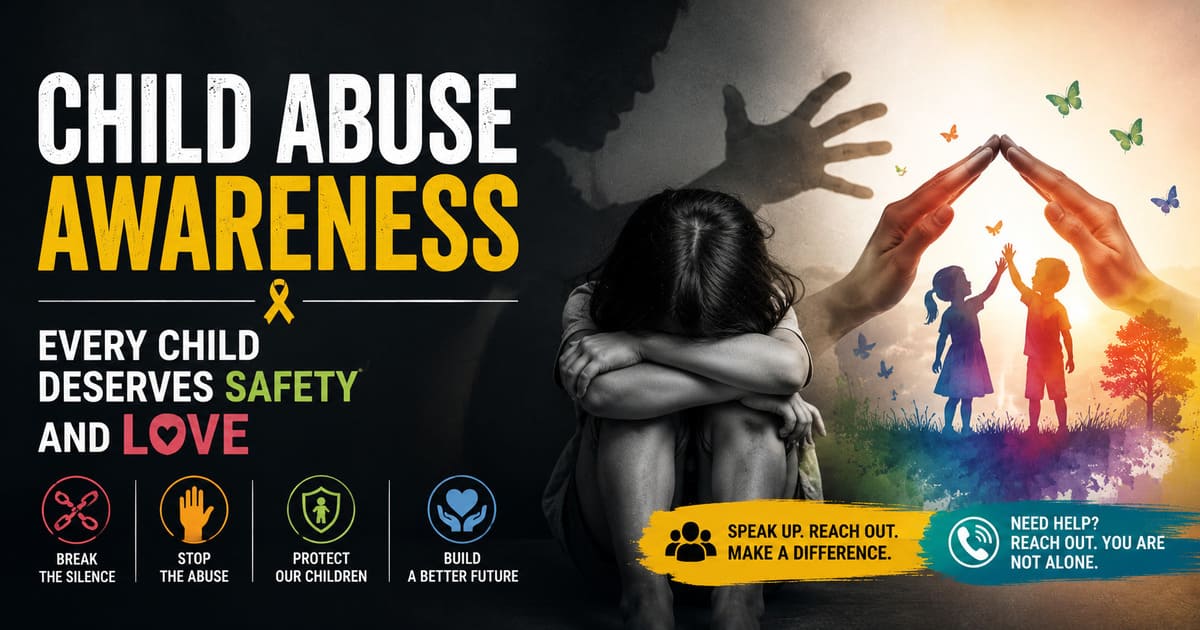
Silence hides the pain — but speaking up saves lives. Let us learn, act, and protect the innocence of childhood.
Introduction: Why This Matters
Child abuse includes physical, emotional, sexual harm, neglect, or exploitation that results in actual or potential harm to a child’s health, survival, development, or dignity. Every year, millions of children suffer in silence. Raising awareness is the first step toward prevention. When communities understand the signs and consequences, they become protectors. A safer world for children is a stronger world for all of us.
Types of Child Abuse
Physical Abuse
Hitting, shaking, burning, or any act causing physical harm. Examples: Unexplained bruises, fractures, or burns.
Emotional Abuse
Constant criticism, rejection, threats, or humiliation. Examples: Belittling, yelling, isolating the child.
Sexual Abuse
Forcing a child into sexual activities, exposure to pornography. Examples: Inappropriate touching, exploitation.
Neglect
Failure to provide food, shelter, medical care, education. Examples: Malnourishment, unsafe living conditions.
Online Exploitation
Grooming, cyberbullying, sextortion, child sexual abuse material. Examples: Predators using social media.
Warning Signs: Know the Red Flags
- Behavioral signs: Sudden aggression, withdrawal, fear of certain adults.
- Physical signs: Unexplained injuries, bruising in unusual shapes, poor hygiene.
- Emotional signs: Low self-esteem, excessive crying, depression, anxiety.
- School indicators: Drop in grades, avoiding activities, frequent absences.
Global Reality: Statistics That Call Us to Act
| Statistic | Reality |
|---|---|
| 1 in 5 | girls and 1 in 13 boys experience sexual abuse before age 18 (UNICEF estimates). |
| ~40% | of abuse cases go unreported globally, according to WHO. |
| 3 in 4 | children aged 2–4 experience violent discipline by caregivers. |
| 120M+ | girls worldwide have experienced forced sexual contact (UNICEF). |
Figures vary by country and reporting methods. Verify latest data from official sources: UNICEF, WHO.
Wisdom for Protection: Quotes on Child Safety
“Every child comes with the message that God is not yet discouraged of man.”
— Rabindranath Tagore
“The child who is not embraced by the village will burn it down to feel its warmth.”
— African Proverb
“Children are the world’s most valuable resource and its best hope for the future.”
— John F. Kennedy
“There can be no keener revelation of a society’s soul than the way it treats its children.”
— Nelson Mandela
“Protecting children from abuse is not just a duty — it’s a sacred trust.”
— Kailash Satyarthi (Nobel Laureate)
“We all have a responsibility to be the voice for those who cannot speak.”
— Unknown
“Safety and security don’t just happen; they are the result of collective consensus and public investment.”
— Nelson Mandela
“A child is a beam of sunlight from the Infinite and Eternal.”
— Lailah Gifty Akita
“The greatest gift you can give a child is your time, attention, and protection.”
— Oprah Winfrey
“If we are to teach real peace in this world, we shall have to begin with the children.”
— Mahatma Gandhi
Long-Term Effects of Child Abuse
- Psychological: PTSD, depression, anxiety, borderline personality disorder, suicidal thoughts.
- Physical: Chronic pain, heart disease, obesity, brain development issues.
- Educational: Dropout rates increase, learning disabilities, concentration difficulties.
- Social: Difficulty trusting others, relationship problems, higher risk of re-victimization.
- Economic: Lost productivity, higher healthcare costs, intergenerational cycles of abuse.
Government Responsibilities: Policy Actions Needed
- Stronger child protection laws & enforcement
- Fast investigation & child-friendly courts
- Anonymous reporting mechanisms & helplines
- School-based awareness & mandatory reporter training
- Stricter penalties & offender registries
- Cybercrime units to combat online exploitation
- Free rehabilitation & mental health services for victims
- National campaigns to break the silence
Punishments & Legal Consequences (General Overview)
Penalties differ across nations. Typical consequences include: Long-term imprisonment, lifetime registration as an offender, heavy fines, restrictions from working with minors, mandatory rehabilitation, and enhanced penalties for repeat offenders. Consult local laws for exact legal provisions. Justice systems are evolving to treat child abuse as a severe crime.
How We Prevent: Roles & Responsibility
- Parents: Open communication, educate children about body safety, model respect.
- Teachers: Report suspicions, implement safe school policies, teach personal safety.
- Communities: Support vulnerable families, after-school programs, neighborhood watch.
- Religious orgs: Background checks for volunteers, zero-tolerance policies.
- Social workers: Early intervention, family support, foster care monitoring.
- Tech companies: AI-based detection of child exploitation, safer platforms for minors.
How to Report Child Abuse (Emergency Steps)
If a child is in immediate danger, call emergency services right away.
Contact local law enforcement or child protective services.
Use national child helpline numbers (available in most countries).
Speak with a trusted adult, teacher, or school counselor.
Document observations safely — do not confront the abuser directly.
Reporting can save a life. Anonymous reporting options exist in many jurisdictions.
Global Resources & External Links
Frequently Asked Questions
What is child abuse?
Child abuse is any action (or inaction) by a parent, caregiver, or other person that causes serious harm to a child. It includes physical, emotional, sexual abuse, neglect, and exploitation.
How can abuse be identified?
By observing unexplained injuries, behavioral changes, fear of specific people, regression in development, or signs of poor hygiene/nutrition. Trust your instincts and report if suspicious.
What should witnesses do?
Document observations safely, report to child protective services or police immediately. Do not confront the alleged abuser. Let professionals investigate.
Can emotional abuse be harmful?
Yes — emotional abuse causes long-term psychological damage, low self-esteem, depression, and impacts brain development. It is often the most hidden form of abuse.
How can schools help?
Schools can implement prevention programs, train staff as mandatory reporters, create safe spaces for children, and run awareness campaigns for students and parents.
Can abuse happen online?
Yes: cyberbullying, grooming, sextortion, exposure to explicit content, and online sexual exploitation. Parents should monitor online activity and teach digital safety.
Why is reporting important?
Reporting stops the abuse, helps the child heal, and may prevent other children from being harmed. Silence protects the abuser, not the child.
How can communities help?
By organizing parent support groups, offering safe recreation for children, educating members about signs of abuse, and creating reporting protocols in local institutions.
What support exists for victims?
Therapy, counseling, crisis intervention, safe shelters, legal aid, and long-term mental health services. Many governments and NGOs provide free resources.
How can prevention improve?
Through comprehensive sex education, parenting classes, economic support for families, public awareness campaigns, and strong child protection systems globally.
Every Child Deserves Safety and Love
Child abuse thrives in silence and ignorance. But when we speak, when we learn, when we report — we break the cycle. Society shares one responsibility: protect every child as if they were our own. Prevention is possible. Reporting saves lives. Education builds safer communities.
Let today be the day you decide to become an active guardian. Share this article, start conversations, and never look away.
Spread Awareness — Share This Post
© Child Abuse Awareness Initiative — Empowering communities to protect children.
Always consult professional authorities and local laws for legal guidance.